
This wet cat food calculator tells you how many cans to feed per day and per meal, how many to buy each week and month, and what that costs. Enter your cat’s weight and life stage, then the can or pouch you usually buy. Feeding a mix of wet and dry? The calculator shares out the calories between them.
How much wet food should a cat eat per day?
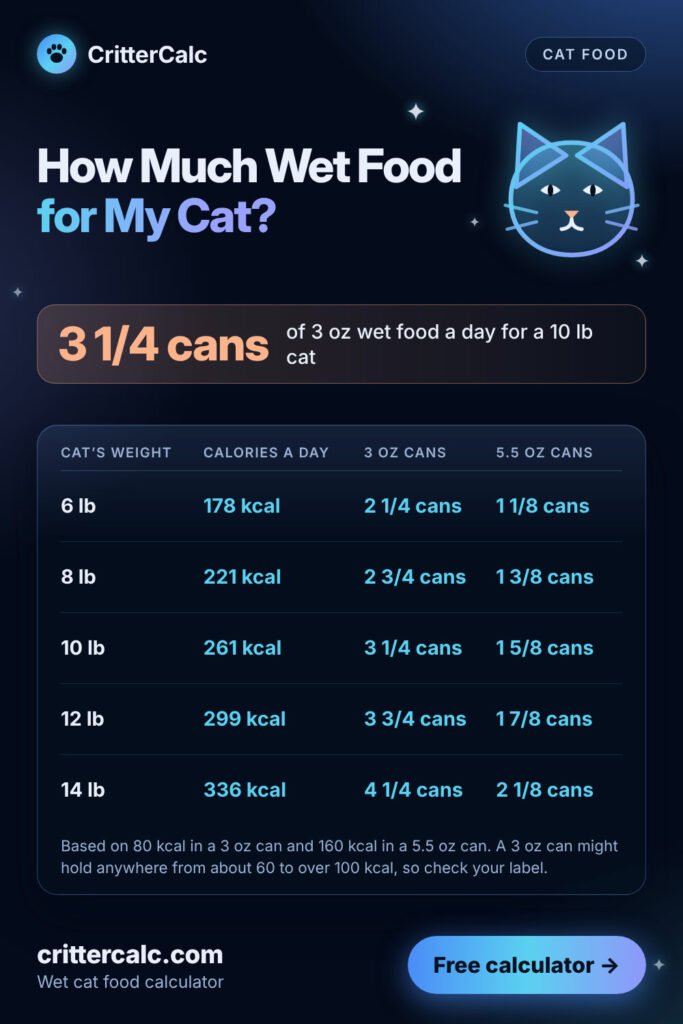
Most healthy adult cats that are spayed or neutered need roughly 24 to 30 calories per pound of body weight a day, and smaller cats sit at the top of that range. For a 10 lb cat, that’s roughly 260 kcal. On an all-wet diet, it comes to about three and a quarter 3 oz cans a day or about 1 5/8 cans in the 5.5 oz size, depending on how many calories your brand packs in.
| Cat’s weight | Calories/day (neutered adult) | 3 oz cans (80 kcal) | 5.5 oz cans (160 kcal) |
|---|---|---|---|
| 6 lb (2.7 kg) | 178 kcal | 2 1/4 cans | 1 1/8 cans |
| 8 lb (3.6 kg) | 221 kcal | 2 3/4 cans | 1 3/8 cans |
| 10 lb (4.5 kg) | 261 kcal | 3 1/4 cans | 1 5/8 cans |
| 12 lb (5.4 kg) | 299 kcal | 3 3/4 cans | 1 7/8 cans |
| 14 lb (6.4 kg) | 336 kcal | 4 1/4 cans | 2 1/8 cans |
Treat these as starting points. Calories per can swing a lot between brands (a 3 oz can might hold anywhere from about 60 to over 100 kcal), so type in the number from your label for an exact answer. Is your cat 14 lb or more? Check the cat weight chart first. Plenty of cats that size are carrying extra weight and should be fed for their ideal weight instead.
How to read a wet cat food label
- Calorie content is usually printed as “kcal/kg” and “kcal/can” (or “kcal per pouch”). Use the per-can number in the calculator.
- Can size is listed in ounces and grams. A “3 oz” can is 85 g, and a “5.5 oz” can is 156 g.
- “Complete and balanced” (an AAFCO statement in the US) means the food can be the only thing your cat eats. Toppers, broths and “complement” foods aren’t complete, so they shouldn’t make up the whole diet.
- Feeding guides on the can are written for an average cat. Lots of indoor, neutered cats need less than the label says.
Wet vs dry food: why so many owners mix
With roughly 75–80% water in every can, wet food gets fluid into cats who don’t drink much, which supports urinary and kidney health. It’s also less calorie-dense than kibble. A cat can eat a satisfying portion without overdoing it, which is handy if you’re watching their weight.
Dry food has its own perks. It costs less, holds up in the bowl longer and works in puzzle feeders. A mix gets you some of both. Choose “half wet, half dry” (or another split) and the calculator shows the portion for each.
Mixing wet and dry cat food: how the split works
The split is done by calories, not by weight or by the size of the scoop. First the calculator works out how many calories your cat needs in a day. Then it gives each food its share and turns that share into cans and cups, using the calorie numbers on your labels.
Here is an example. A 10 lb neutered adult needs about 261 kcal a day. On a half and half plan, that is about 130 kcal from wet food and 130 kcal from dry. With 3 oz cans at 80 kcal each, that comes to about 1.6 cans. Kibble at 400 kcal per cup works out to roughly a third of a cup. If you give treats too, keep them under 10% of the day’s calories, as the AAHA feeding guidelines advise, and take them off the total first.
Serving and storing wet food
- Split the day’s food into two to four small meals. That’s closer to how cats naturally eat than one big bowl.
- Keep opened cans covered in the fridge and use them within 2–3 days. Serve at room temperature, since a lot of cats turn their nose up at cold food. Don’t microwave it until it’s hot.
- Don’t leave wet food out all day. Pick up leftovers after about 30 minutes to 2 hours, sooner in warm weather.
- Switch foods slowly over 7–10 days, mixing in a bit more of the new food each day.
- Check the scale every month or so. Weight going up or down when it shouldn’t? Nudge portions by about 10% and recheck.
The math behind the numbers
First we work out your cat’s resting energy requirement (RER = 70 × body weight in kg0.75). Then we multiply it by a life-stage factor: 1.2 for a neutered adult, 1.4 intact, 1.0 for inactive cats, 0.8 for weight loss (at ideal weight) and 2.5 for kittens. The wet-food share of those calories gets divided by the kcal in one can or pouch. Weekly and monthly totals are rounded up so you don’t run short.
How much to feed: a vet’s rule of thumb
Dr. Sarah Wooten, a veterinarian who presents for Cats.com, gives a simple ceiling in her video on feeding cats. An average house cat, she says, should eat about 250 to 300 calories a day: around 250 for a 6 to 7 lb cat and around 320 for a 13 to 14 lb cat. She also points out that dry food often packs 400 to 450 calories into one cup, which is why kibble portions look so small.
Her numbers line up with this calculator at the upper weights. It gives a 10 lb neutered adult 261 kcal and a 13.5 lb one 327 kcal, using the factor from the Merck Veterinary Manual. For a small 6.5 lb cat the same formula gives about 190 kcal, which is under her 250. She gives that figure as a ceiling, so the lower result is the safer place to start. Then watch the body shape and adjust.
Three more of her tips fit wet food well:
- Feed meals, morning and evening. Cats hunt at dawn and dusk, so two meals suit them. A bowl that is always full makes it hard to know how much a cat eats.
- Mix canned and dry. She likes to move part of the day’s calories into canned food, served morning and night. Canned food is high in moisture and protein, which helps a cat feel full for longer.
- Weigh the food. A kitchen scale in grams is more exact than a cup, and she notes that even one or two extra kibbles a day add up.
Frequently asked questions
How many cans of wet food should my cat eat a day?
About 3 to 3 1/2 small cans for a 10 lb cat. That assumes a typical adult eating only wet food. In large (5.5 oz) cans it’s about 1 1/2 to 1 3/4. Smaller or less active cats need less, and kittens need more per pound.
Is one can of wet food a day enough for a cat?
No, not on its own. One 3 oz can (about 80 kcal) is only a third of what an average adult cat needs. It works as part of a mixed diet if the rest comes from dry food. Try the “1/4 wet” option to see how much kibble to add.
How much wet food should a kitten eat?
About 2.5 times their resting energy, split into 3–4 meals. A 4 lb kitten needs roughly 270 kcal a day, or about three and a half 3 oz cans. While they are growing, redo the sum every two weeks or so.
Can I leave wet cat food out all day?
Better not. Wet food spoils at room temperature and draws flies. Offer measured meals and take away whatever isn’t eaten within a couple of hours.
How many ounces of wet food should a cat eat a day?
It depends on your cat’s weight and the food. With 3 oz cans at 80 kcal, an 8 lb cat eats about 8 oz a day and a 10 lb cat about 10 oz, so roughly 1 oz per pound of body weight. The calculator shows ounces and grams for your cat.
Save to Pinterest