
This dog food and calorie calculator tells you how much to feed each day, in cups (or cans) and calories, once you enter your dog’s weight, life stage and the calories in your food. To give a feel for the numbers: at 10 lb, a spayed or neutered pet dog uses about 35 calories for each pound it weighs, and at 100 lb only about 20. Per pound, the little ones eat a lot more.
How to use the dog food calculator
- Weigh your dog. A bathroom scale works fine. Weigh yourself, then weigh yourself holding your dog, and subtract. If your dog needs to slim down, enter the target weight your vet recommends, not the current one.
- Pick the life stage and activity level. Most spayed or neutered family pets belong under “Adult, spayed/neutered”. Save the working-dog options for dogs that actually put in hours of work a day.
- Find the calories in your food. Look for “kcal/cup” or “kcal/can” on the bag or can. It’s usually near the guaranteed analysis. Not printed? Check the brand’s website.
- Choose meals per day. Two meals suit most adults. Puppies usually eat three or four.
Want to know when to buy the next bag? The bag calculator further down turns the daily amount into days, cups and cost.
Dog calorie chart: how much should I feed my dog?
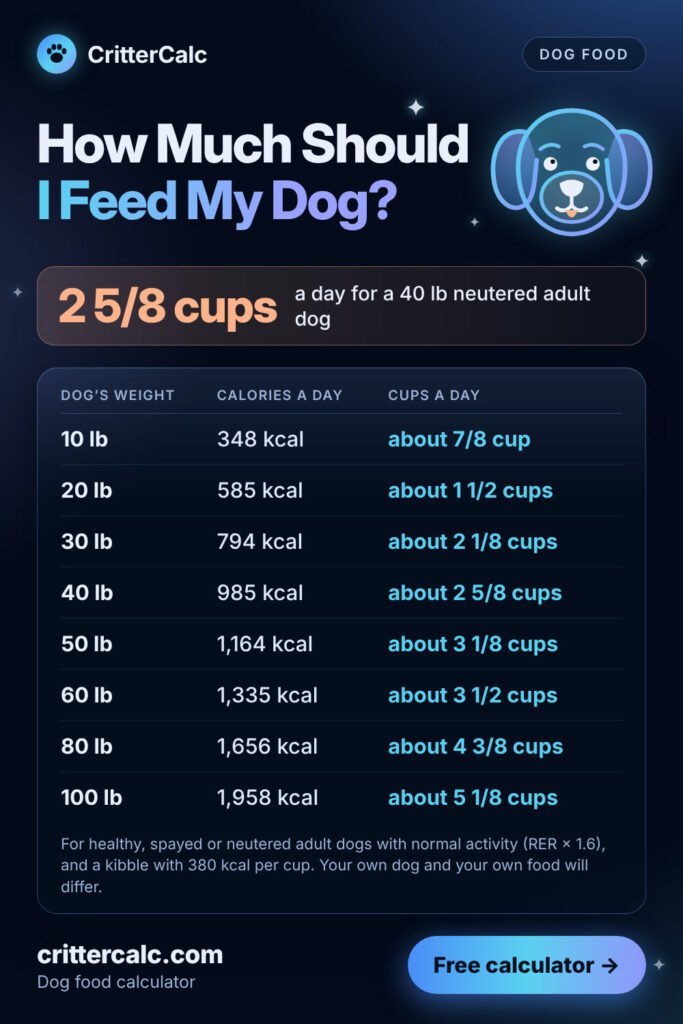
Here are typical daily calories for healthy, spayed or neutered adult dogs with normal activity (RER × 1.6), plus the cups of an average 380 kcal/cup kibble. Your own dog and your own food will differ, which is what the calculator is for.
| Dog’s weight | Calories per day | Cups per day (380 kcal/cup) |
|---|---|---|
| 5 lb (2.3 kg) | 207 kcal | about 1/2 cup |
| 10 lb (4.5 kg) | 348 kcal | about 7/8 cup |
| 20 lb (9.1 kg) | 585 kcal | about 1 1/2 cups |
| 30 lb (13.6 kg) | 794 kcal | about 2 1/8 cups |
| 40 lb (18.1 kg) | 985 kcal | about 2 5/8 cups |
| 50 lb (22.7 kg) | 1,164 kcal | about 3 1/8 cups |
| 60 lb (27.2 kg) | 1,335 kcal | about 3 1/2 cups |
| 70 lb (31.8 kg) | 1,498 kcal | about 4 cups |
| 80 lb (36.3 kg) | 1,656 kcal | about 4 3/8 cups |
| 100 lb (45.4 kg) | 1,958 kcal | about 5 1/8 cups |
Look at how the calories climb. They don’t go up in a straight line. A 100 lb dog eats about five and a half times what a 10 lb dog does, not ten times. Smaller bodies lose heat faster, so they burn more per pound.
How long will a bag of dog food last?
Once you have the daily amount, this second calculator tells you when the bag will run out. Enter the bag size and what you feed per day. If you feed by the cup, add the two calorie numbers from the label, because they show how heavy one cup of your kibble is. Put in the price as well and you get the cost per day.
How many cups are in a pound of dog food?
No single number fits every food. A cup measures space and a pound measures weight, so dense kibble gives fewer cups per pound than light, airy kibble. The label lets you work out the figure for your own food:
grams in one cup = kcal per cup ÷ kcal per kg × 1,000
cups in one pound = 453.6 ÷ grams in one cup
Say the bag lists 3,600 kcal/kg and 380 kcal/cup. One cup then weighs 380 ÷ 3,600 × 1,000 = 106 g, and a pound holds 453.6 ÷ 106 = 4.3 cups. A 30 lb bag of that food holds about 129 cups, which is 43 days of food at 3 cups a day.
On a US bag you should find both numbers. AAFCO’s guide to reading pet food labels says the calorie statement must give kilocalories per kilogram and also per familiar unit, such as a cup. The table shows how much the weight of a cup changes the count.
| Bag size | 90 g per cup | 110 g per cup | 130 g per cup |
|---|---|---|---|
| 1 lb | 5.0 cups | 4.1 cups | 3.5 cups |
| 5 lb | 25 cups | 21 cups | 17 cups |
| 15 lb | 76 cups | 62 cups | 52 cups |
| 20 lb | 101 cups | 82 cups | 70 cups |
| 30 lb | 151 cups | 124 cups | 105 cups |
| 40 lb | 202 cups | 165 cups | 140 cups |
| 50 lb | 252 cups | 206 cups | 174 cups |
The math behind the numbers
The calculator uses the same two-step method vets use when they work out a diet.
Step 1: energy at rest (RER)
RER = 70 × (body weight in kg)0.75
The letters stand for resting energy requirement, meaning the calories a dog gets through in a day spent resting in a room that is neither hot nor cold. For a 15 kg (33 lb) dog that is 70 × 150.75, or about 534 kcal.
Step 2: the daily total (MER)
Real dogs don’t lie still. They walk, play, grow and keep warm, so RER gets multiplied by a life-stage factor to give the maintenance energy requirement (MER). These are the factors:
| Life stage / activity | Factor (× RER) |
|---|---|
| Adult, spayed or neutered | 1.6 |
| Adult, intact | 1.8 |
| Low activity adult | 1.4 |
| Inactive or prone to weight gain | 1.2 |
| Weight loss (at target weight) | 1.0 |
| Puppy under 4 months | 3.0 |
| Puppy 4–12 months | 2.0 |
| Active / light work | 2.0 |
| Moderate work | 3.0 |
| Heavy work | 5.0 |
Where the factors come from: the intact, neutered and puppy factors are in the Merck Veterinary Manual. For a dog that does little or puts on weight easily the sources run from 1.0 to 1.4 (Merck 1.4, AAHA 1.0 to 1.2), and the calculator offers 1.4 and 1.2. The weight loss and work factors follow Box 1 of the 2021 AAHA nutrition guidelines, which gives ranges for work: 1.6 to 2.0 for light, 2.0 to 5.0 for moderate and 5.0 to 11.0 for heavy. We use one figure from each range. AAHA also notes that sedentary or indoor pets may need less than its table says, and Merck says one animal can need up to 30% more or less than another of the same weight. That is why the body check below counts for more than the sum.
Last, we divide the daily calories by the calories in one cup or can of your food. That’s why the kcal number on the label matters so much. Two foods can differ by 100 kcal or more per cup, and over a month that adds up fast.
Is my dog at the right weight?
The numbers get you started. Your dog’s body tells you if they’re right. Vets judge this with a Body Condition Score (BCS) from 1 to 9, and they want to see a 4 or a 5. You’re in good shape if:
- the ribs are easy to feel through a thin fat cover, with no hard pressing
- looking down from above, a waist shows just behind the ribs
- from the side, the belly line rises from the chest toward the back legs.
Can’t find the ribs, or no waist? Cut the daily amount by about 10% and recheck in 2–4 weeks. If the ribs, spine or hip bones stand out, add 10% and talk to your vet.
Tips for feeding the right amount
- Use a real measuring cup. A pet store “scoop” or a coffee mug can hold 1.5–2 real cups. A kitchen scale beats both.
- Count the treats. Keep treats, chews and table scraps below 10% of the day’s calories. The calculator works out that treat budget for your dog.
- Recalculate whenever you change foods. A different kcal per cup means a different portion, even if the bag looks almost the same.
- Dogs that are much more active in summer, or spend winters outdoors, may need more food at those times of year.
- Change to a new food gradually, over 7–10 days, to avoid an upset stomach.
A vet’s two-step check
Dr. Hillary Wolfe, a veterinarian who teaches home feeding, uses the same math as this calculator in her two-step feeding guide. Step one is the dog’s daily calories. Step two is the calories in the food. Divide the first by the second and you have the amount to feed.
Her own small dog is the example. The resting need comes to 216 calories, she multiplies by 1.2 for activity, and gets 259 calories a day. Put a 10 lb dog into the calculator above with the “Couch potato / gains weight easily” setting and you get 261, a match within two calories. A typical neutered pet of that weight, at the Merck factor of 1.6, comes out at 348.
She also shows why cups mislead. In her video three quarters of a cup of kibble holds 300 calories, while the same volume of fresh food holds 86. That is why this calculator asks for the calories printed on your bag or can. If you cook at home, she warns that most recipes found online are not balanced, and a recipe without a calorie figure cannot be portioned at all.
Frequently asked questions
How many calories does my dog need a day?
Weight matters most. A spayed or neutered 20 lb dog burns around 585 kcal a day. At 50 lb it’s closer to 1,164 kcal, so not even double the food for two and a half times the weight. Want to do the sum yourself? Weight in kg to the power 0.75, times 70, then times 1.6. Puppies and working dogs need a lot more, so pick their option in the calculator. And check their weight again every few weeks.
How many cups of food should my dog eat a day?
It depends on weight and how rich the food is. A 30 lb adult neutered dog eating a 380 kcal/cup kibble needs about 2 1/8 cups a day, split into two meals. A 60 lb dog needs about 3 1/2 cups. The calculator gives your dog’s exact amount.
Is the feeding guide on the dog food bag accurate?
It’s a fair starting range, but it often runs high. Bag guides are written for fairly active, intact dogs, not spayed or neutered pets that rest most of the day.
How much should I feed my puppy?
About three times their resting energy until 4 months, then about twice until they’re grown. Pick the puppy option in the calculator and recalculate every couple of weeks as your puppy gains weight. Large-breed puppies should grow steadily, not fast, so don’t overfeed.
How much should I feed my dog to lose weight?
Base the amount on the weight your dog should be, not the weight it is now. Choose “Weight loss” and enter the goal weight. That gives roughly RER at the ideal weight, which usually means a safe loss of 1–2% of body weight per week. Weigh your dog every two weeks and plan the diet with your vet.
How many times a day should a dog eat?
Twice a day is the usual answer for adult dogs, leaving 8–12 hours between the two meals. Puppies need three or four. Large, deep-chested breeds may do better with smaller, more frequent meals.
Does the calculator work for wet food?
Yes. Choose “Wet / canned food” and enter the kcal per can. Feeding a mix? Work out how many calories come from the wet part, subtract that from the daily total, and feed the rest as kibble.
How many cups does a 15, 30 or 40 lb bag of dog food hold?
That depends on how heavy the kibble is. At 110 g per cup, a 15 lb bag holds about 62 cups, a 30 lb bag about 124 cups and a 40 lb bag about 165 cups. Lighter kibble gives more cups and heavier kibble gives fewer. The bag calculator on this page gets the count for your food from the two calorie numbers on the label.
How many days does a 30 lb bag last at 3 or 4 cups a day?
About 43 days at 3 cups a day, or about 32 days at 4 cups a day, for a food where one cup weighs 106 g. That bag holds about 129 cups. Heavier kibble means fewer cups in the same bag, so at the same daily amount it runs out sooner.
Save to Pinterest