
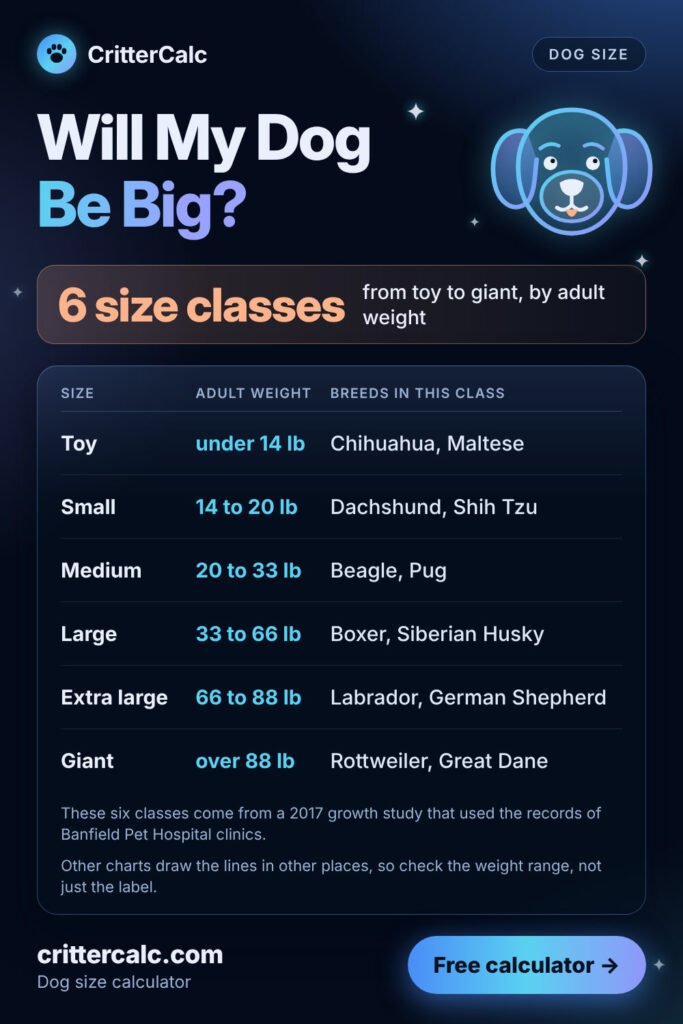
This dog size chart sorts dogs into six weight classes: toy under 14 lb, small from 14 to 20 lb, medium from 20 to 33 lb, large from 33 to 66 lb, extra large from 66 to 88 lb and giant above that. The classes come from a 2017 growth study built on vet clinic records. Other charts cut the scale in other places, so this page also sets three published charts side by side and shows where 33 breeds fall.
Is your dog still growing? Then its class depends on the weight it will reach as an adult. Our puppy weight calculator estimates that number, and the size calculator further down this page turns a puppy’s age and weight into a size group.
Dog size chart by weight
| Size | Weight in pounds | Weight in kilograms | Breeds the study placed here |
|---|---|---|---|
| Toy | under 14 lb | under 6.5 kg | Chihuahua, Maltese, Pomeranian |
| Small | 14 to 20 lb | 6.5 to 9 kg | Dachshund, Shih Tzu, Bichon Frise |
| Medium | 20 to 33 lb | 9 to 15 kg | Beagle, Pug, Boston Terrier |
| Large | 33 to 66 lb | 15 to 30 kg | Boxer, Siberian Husky, Basset Hound |
| Extra large | 66 to 88 lb | 30 to 40 kg | Golden Retriever, Labrador Retriever, German Shepherd |
| Giant | over 88 lb | over 40 kg | Rottweiler, Great Dane, Mastiff |
These are the six weight categories of the 2017 growth study, which used the records of Banfield Pet Hospital clinics. The paper numbers them I to VI, and toy to giant are our names for them. It works in kilograms, and the classes change at 6.5 kg, 9 kg, 15 kg, 30 kg and 40 kg, so the pound figures are rounded. Our puppy growth chart draws a separate set of growth lines for each of these classes.
What size is my dog? One weight on three charts
No single rule says where medium stops and large begins. The sources behind this page draw the lines in three different places, so one dog can carry two labels. Find your dog’s weight in the first column to see what each chart calls it.
| Dog’s weight | Growth study | AKC chart | Older scale | Same label? |
|---|---|---|---|---|
| Under 11 lb (under 5 kg) | Toy | Small | Toy | Toy or small |
| 11 to 14 lb (5 to 6.5 kg) | Toy | Small | Small | Toy or small |
| 14 to 20 lb (6.5 to 9 kg) | Small | Small | Small | Small on all three |
| 20 to 22 lb (9 to 10 kg) | Medium | Medium (from 21 lb) | Small | Small or medium |
| 22 to 33 lb (10 to 15 kg) | Medium | Medium | Medium | Medium on all three |
| 33 to 50 lb (15 to 23 kg) | Large | Medium | Medium | Medium or large |
| 50 to 55 lb (23 to 25 kg) | Large | Large (from 51 lb) | Medium | Medium or large |
| 55 to 66 lb (25 to 30 kg) | Large | Large | Large | Large on all three |
| 66 to 88 lb (30 to 40 kg) | Extra large | Large | Large | Large or extra large |
| 88 to 100 lb (40 to 45 kg) | Giant | Large | Giant | Large or giant |
| Over 100 lb (over 45 kg) | Giant | Extra large | Giant | Extra large or giant |
Only three stretches of the scale get one label everywhere: 14 to 20 lb is small, 22 to 33 lb is medium and 55 to 66 lb is large. Outside them the answer depends on the chart.
Here is what that does to real dogs. At 50 lb, a dog is large in the study classes and medium on the other two scales. At 75 lb it is extra large in the study and plain large elsewhere. At 95 lb it is a giant in the study and on the older scale, but still large on the AKC chart. Even Waltham’s own chart pages call a dog under 9 kg “toy” in one line and “small” in another.
The growth study column is the one our puppy tools use. It and the older scale both come from the 2017 paper. Its authors began with the older five classes, then regrouped the breeds by how their growth curves clustered, which produced six weight classes. The older scale cut at 5, 10, 25 and 40 kg. The AKC chart column is the American Kennel Club’s growth chart, which sorts dogs into four weight bands. Our dog years chart works with the same four bands.
So when a food bag, a crate label or a groomer’s price list says “large”, check the weight range printed next to it. Our puppy tools stick to the study classes because the growth data was built on them.
What is considered a small, medium or large dog?
That depends on whose chart you read. This table gives the weight range behind each label on the three scales.
| Label | Older scale | Growth study | AKC chart |
|---|---|---|---|
| Toy | under 11 lb | under 14 lb | not used |
| Small | 11 to 22 lb | 14 to 20 lb | up to 20 lb |
| Medium | 22 to 55 lb | 20 to 33 lb | 21 to 50 lb |
| Large | 55 to 88 lb | 33 to 66 lb | 51 to 100 lb |
| Extra large | not used | 66 to 88 lb | over 100 lb |
| Giant | over 88 lb | over 88 lb | not used |
What is considered a small dog?
A dog that weighs 14 to 20 lb (6.5 to 9 kg) is small on all three charts. Below that the charts split. The growth study says toy under 14 lb and the older scale says toy under 11 lb. The AKC chart has no toy band at all, so it counts every dog up to 20 lb as small.
What is considered a medium sized dog?
From 22 to 33 lb (10 to 15 kg) a dog is medium whichever chart you pick. The AKC chart keeps the medium label up to 50 lb and the older scale up to 55 lb. The growth study stops medium at 33 lb, which is why a 40 lb dog is medium for some people and large for others.
What is considered a large dog?
Every chart agrees on large between 55 and 66 lb (25 to 30 kg). The AKC chart runs large all the way from 51 to 100 lb. The text of the same AKC guide sets the bar higher than its chart does. It describes large to giant breed puppies as dogs whose adult weight is usually 70 lb or above.
What is considered an extra large or giant dog?
Past 88 lb (40 kg) a dog is giant in the growth study and on the older scale. The AKC chart never uses the word giant. Its top band is called X-Large and starts at 100 lb. The 66 to 88 lb class that we call extra large holds Labradors, German Shepherds and Golden Retrievers. On the other two charts that weight still counts as large.
Dog size chart by breed
Table 1 of the growth study lists 33 breeds and the category each one falls in. Here they are in alphabetical order, with the label the same breed had on the older five-class scale. Eleven breeds change label between the two.
| Breed | Size in the growth study | Weight class | Older scale |
|---|---|---|---|
| American Bulldog | Extra large | 66 to 88 lb (30 to 40 kg) | Large |
| American Cocker Spaniel | Medium | 20 to 33 lb (9 to 15 kg) | Medium |
| Australian Shepherd | Large | 33 to 66 lb (15 to 30 kg) | Medium |
| Basset Hound | Large | 33 to 66 lb (15 to 30 kg) | Medium |
| Beagle | Medium | 20 to 33 lb (9 to 15 kg) | Medium |
| Bichon Frise | Small | 14 to 20 lb (6.5 to 9 kg) | Small |
| Boston Terrier | Medium | 20 to 33 lb (9 to 15 kg) | Medium |
| Boxer | Large | 33 to 66 lb (15 to 30 kg) | Large |
| Chihuahua | Toy | under 14 lb (under 6.5 kg) | Toy |
| Chow Chow | Large | 33 to 66 lb (15 to 30 kg) | Medium |
| Dachshund | Small | 14 to 20 lb (6.5 to 9 kg) | Small |
| English Bulldog | Large | 33 to 66 lb (15 to 30 kg) | Large |
| Fox Terrier | Medium | 20 to 33 lb (9 to 15 kg) | Small |
| German Shepherd | Extra large | 66 to 88 lb (30 to 40 kg) | Large |
| Golden Retriever | Extra large | 66 to 88 lb (30 to 40 kg) | Large |
| Great Dane | Giant | over 88 lb (over 40 kg) | Giant |
| Jack Russell Terrier | Small | 14 to 20 lb (6.5 to 9 kg) | Small |
| Labrador Retriever | Extra large | 66 to 88 lb (30 to 40 kg) | Large |
| Lhasa Apso | Small | 14 to 20 lb (6.5 to 9 kg) | Small |
| Maltese | Toy | under 14 lb (under 6.5 kg) | Toy |
| Mastiff | Giant | over 88 lb (over 40 kg) | Giant |
| Miniature Pinscher | Toy | under 14 lb (under 6.5 kg) | Small |
| Miniature Schnauzer | Small | 14 to 20 lb (6.5 to 9 kg) | Small |
| Pekingese | Small | 14 to 20 lb (6.5 to 9 kg) | Small |
| Pit Bull type | Large | 33 to 66 lb (15 to 30 kg) | Large |
| Pomeranian | Toy | under 14 lb (under 6.5 kg) | Toy |
| Pug | Medium | 20 to 33 lb (9 to 15 kg) | Small |
| Rat Terrier | Small | 14 to 20 lb (6.5 to 9 kg) | Small |
| Rottweiler | Giant | over 88 lb (over 40 kg) | Large |
| Shih Tzu | Small | 14 to 20 lb (6.5 to 9 kg) | Small |
| Siberian Husky | Large | 33 to 66 lb (15 to 30 kg) | Large |
| Toy Poodle | Toy | under 14 lb (under 6.5 kg) | Toy |
| Yorkshire Terrier | Toy | under 14 lb (under 6.5 kg) | Toy |
The class belongs to the breed as a whole, so one dog can be lighter or heavier than its breed’s class. For a mixed breed, or a breed that is not in the table, go by weight in the first chart.
Size group calculator for a growing puppy
This dog size calculator estimates your puppy’s adult weight and names the size group that weight belongs to, from toy to giant. It needs an age and a weight, and it works for mixed breeds too. Add the parents’ weights if you have them and it will only look at the size groups between the two. For a grown dog, it reads the size group straight off the weight.
What to enter
- Age. Weeks work best for a young puppy. The growth data starts at 8 weeks, so a younger pup cannot be sized yet. For a grown dog, switch the box to months.
- Weight today. Put a tiny puppy on a kitchen scale. With a bigger dog, step on the bathroom scale holding the dog, then again without, and subtract.
- Parents’ weights, if you know them. Use healthy adult weights. With both parents entered, the calculator tries only the size groups from the lighter parent to the heavier one. With one parent, it tries that parent’s group first.
You get an adult weight with a likely range, the size group, the share of growing already done, and the age at which dogs of that size count as full grown. If your puppy’s own growth points to a different size than the parents, the result says so.
Dog size chart for clothes, collars and harnesses
A weight class cannot tell you whether your dog takes an L or an XL coat. The American Kennel Club’s measuring guide warns that sizing changes from brand to brand, and sometimes between two styles from one brand. It names three measurements that most dog clothing and gear are sized by:
- Back length. From the base of the neck, about where the collar rests, along the spine to the base of the tail.
- Chest girth. Right round the widest part of the ribs, which is normally right behind the front legs. For clothes and harnesses the AKC treats this as the number that usually matters most.
- Neck girth. Round the neck at the spot where a collar sits. A collar needs no other measurement.
Take all three with your dog standing. For the two girths, the AKC’s tip is to slip two fingers under the tape so the fit is not too tight. It also says to pick the bigger size when your dog falls between two. Then hold your numbers against the chart printed for that exact product.
Pet Circle veterinarian Dr. Carla measures the same spots in a harness fitting video. Two numbers are enough for a harness, Dr. Carla explains: the neck, at the place a collar usually rests, and the chest at its thickest point. No tape measure at home? A piece of string held against a ruler does the job.
How the calculator picks a size group
It runs on the same growth lines as our puppy weight calculator: our own analysis of the public records behind the 2017 study, 73,694 healthy puppies in all. For every size group it finds the line your puppy sits on today and follows that line forward until the group’s growth is over, somewhere between 55 and 80 weeks. Then it keeps the group whose adult weight range holds the answer. If two groups fit, it takes the one where your puppy is closer to the middle line and lists the other in the notes.
Waltham teaches vet teams a similar test in its video guide to the charts. Pick the chart where the puppy’s weight lands on or between the 9th and 91st centile lines, then judge that pick again after three weigh-ins taken a month apart. If it turns out to be the wrong chart, the earlier weights are simply copied to the right one. Our calculator repeats the test every time you enter a new weight.
Why the parents help
One weigh-in can fit two neighbouring groups. For a crossbreed, Waltham suggests starting from what the mother and father weigh, if that is known. When the parents fall in two different weight classes, or were not at a healthy weight themselves, it says to make a first guess and correct it later. The calculator works in the same order. The parents narrow the choice first, and your puppy’s growth line then decides between the groups that are left. When that line lands outside the parents’ groups altogether, the result flags it so you can recheck the numbers and weigh again.
No idea who the parents were? Waltham names three other helpers: a breeder who knows the line, your vet’s opinion, and a DNA test that shows the likely parent breeds.
What this page leaves out, and why
Height. We do not estimate adult height. We looked for measured height-by-age data that covers every size of dog and found none, so any figure would be a guess. For a purebred, the AKC’s breed pages give the usual adult height. A Labrador Retriever, for example, is listed at 22.5 to 24.5 inches for males and 21.5 to 23.5 inches for females. The AKC also says most puppies are done gaining height by 12 months, though big dogs may go on developing until they are 18 to 24 months old.
Sex. Our growth lines pool males and females, so the estimate does not change with sex. Waltham notes that males grow more rapidly than females, and the AKC’s Labrador figures show what that adds up to: 65 to 80 lb for males against 55 to 70 lb for females.
A vet on why sizing dogs took so long
Dr Alex German of the University of Liverpool is one of the authors of the 2017 study. In an interview filmed for Waltham he explains why dogs had no evidence-based growth standards before it. Modelling dog growth is hard, he says: “you need a big population, you need to try to ensure they’re healthy”, and then the right maths on top. One chart cannot serve a Chihuahua and a Mastiff. That is why the study ended up with separate size classes, and why this calculator has to settle the size group before it can say anything about weight.
He gives the adult number a second job as well. Once a dog has grown up along a healthy line, the weight it arrives at can be carried forward as a precise reference for later weight checks. His advice is to do the tracking together with a vet, who can weigh accurately and read the chart, because a healthy dog’s weights can still wobble from one visit to the next.
What the size group changes day to day
- How long your puppy keeps growing. Waltham says a dog under 9 kg is fully grown at about a year and a 30 to 40 kg dog at about 18 months, while some giant breeds are not done for nearly two years. The calculator shows the age for your dog’s group.
- Which puppy food fits. The AKC’s chief veterinarian, Dr. Jerry Klein, says a calcium level that is too high or too low hurts large and giant puppies more than small ones, so they do best on a food made for large-breed growth. The AKC starts counting a puppy as large to giant at an adult weight of about 70 lb. On our scale that means most of the extra-large group and every giant.
- When hard exercise is safe. Dr. Klein’s rule is no jogging or road work until a dog is 14 to 18 months old, most of all for large and giant breeds, because the growth plates need to close first.
- What to buy once. A crate, a car harness and a bed sized for the adult weight save you from buying them twice.
Once you know the target weight, set the daily portion with our dog food calculator, and compare your puppy with others of the same size on the puppy growth chart.
Frequently asked questions
What are the different dog sizes?
The three charts on this page use four, five and six labels. This page follows the six weight classes of a 2017 growth study: toy, small, medium, large, extra large and giant. The AKC’s growth chart has four bands, from small to X-Large, and an older scale has five, with no extra large.
Is a 50 lb dog medium or large?
Both answers are in use. A 50 lb (23 kg) dog is large in the six growth-study classes this calculator follows, where large runs from 33 to 66 lb. On the AKC’s growth chart the same dog sits at the very top of medium (21 to 50 lb), and on the older five-class scale it is medium too. Go by the weight range on the product you are buying.
Is my dog a large or an extra large?
By weight, a dog of 66 to 88 lb is extra large in the growth study classes and large on the other two charts. For a coat or a harness, L and XL change from brand to brand. Measure the chest and compare it with that product’s own size chart.
What size is a Beagle, a Golden Retriever or a German Shepherd?
In the growth study a Beagle is a medium dog, in the 20 to 33 lb class. Golden Retrievers and German Shepherds are both in the 66 to 88 lb class, which we call extra large. The older scale has them as large dogs. The breed table on this page covers 33 breeds.
How do I measure my dog’s size?
For a size class the weight is all you need. For clothing and gear the AKC lists three measurements, each taken with the dog standing: neck girth, chest girth and back length.
How big will my mixed breed puppy get?
Enter the age and weight, plus the parents’ weights if you know them. With no parent information the calculator tests the six size groups one by one and picks the best match for your puppy’s growth line. The AKC’s Dr. Jerry Klein says sizing a dog whose parents are unknown is partly guesswork, above all for puppies of 6 to 10 weeks, so run the numbers again every two weeks while your puppy is growing.
How tall will my puppy get?
This calculator cannot tell you, and we would rather say so than guess: we found no measured height data that covers all sizes. For a purebred, look up the breed on the AKC site, which lists the usual adult height. For a mix there is no table to look up, so ask your vet at the next check.
Are male dogs bigger than females?
Within a breed, usually yes. Waltham says males grow more rapidly than females and prints separate charts for each sex. The AKC’s figures for the Labrador Retriever show the gap: 65 to 80 lb for males and 55 to 70 lb for females. Our growth lines pool both sexes, so the estimate here is the same for a male and a female.
Is a dog full grown at 6 months?
No. In our data the median puppy has reached 78% of adult weight at 6 months in the toy group and only 62% in the giant group. The AKC’s chart is more cautious for big dogs, at 60% for large and 50% for extra-large breeds, so plan for the slower figure if you are buying for a big puppy.
Can I use the calculator for an adult dog?
Yes. Enter the age in months and the weight, and the calculator reads the size group straight from the weight. The groups assume a healthy weight, so for a dog that is overweight or too thin, use the weight your vet considers ideal.
Save to Pinterest