
Is your puppy growing the way it should? This chart compares your puppy with real puppies, not a guess. We used 124,316 vet weigh-ins from 73,694 healthy purebred puppies seen at US clinics. It’s the same open data set behind the WALTHAM and University of Liverpool puppy growth charts.
Puppy weight chart by month
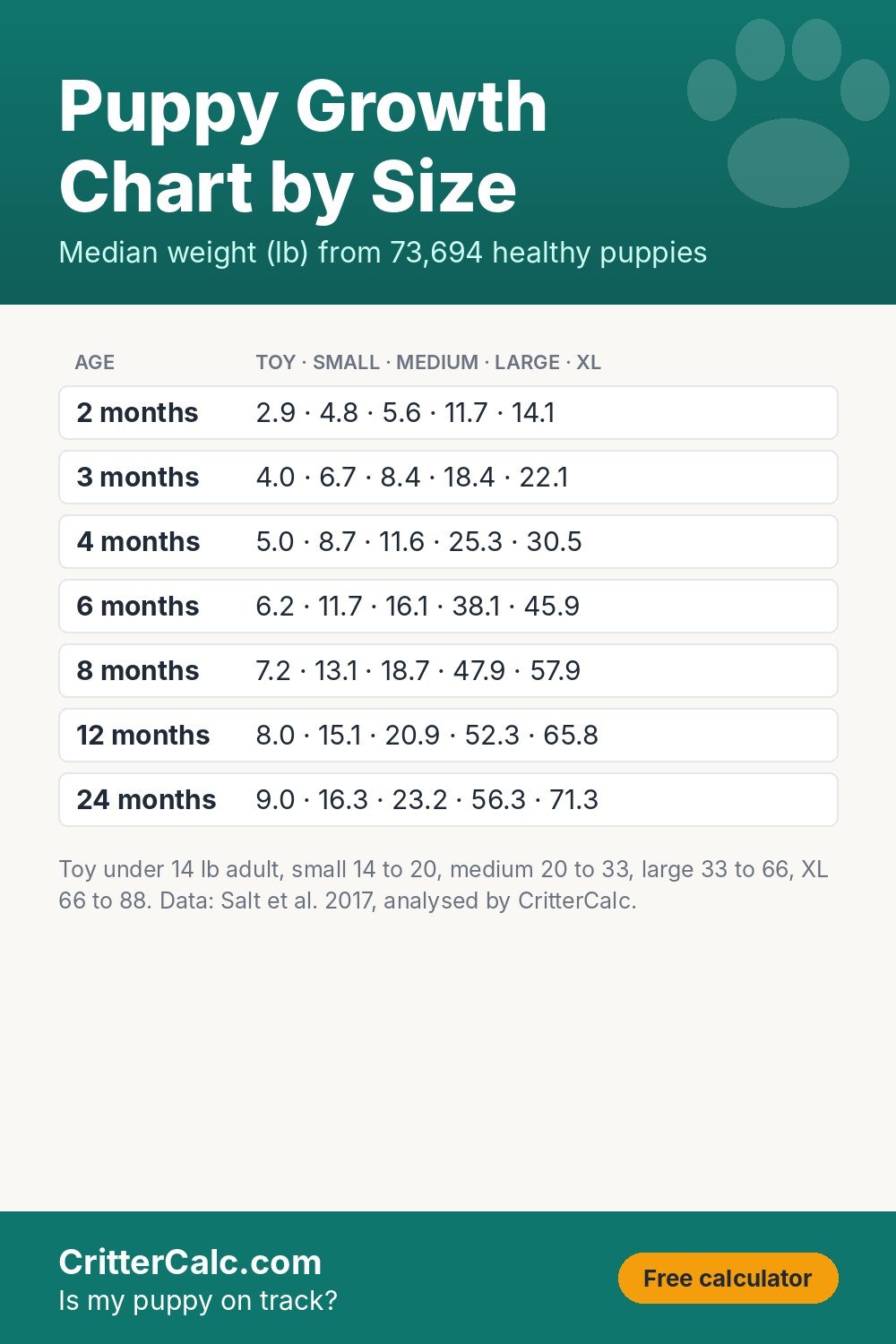
This is the median weight, in pounds, for each size group. Half of the healthy puppies in the data were lighter and half were heavier. Pick the group by the adult weight you expect, not by how big your puppy looks today.
| Age | Toy | Small | Medium | Large | Extra large | Giant |
|---|---|---|---|---|---|---|
| 2 months | 2.9 | 4.8 | 5.6 | 11.7 | 14.1 | 15.7 |
| 3 months | 4.0 | 6.7 | 8.4 | 18.4 | 22.1 | 26.7 |
| 4 months | 5.0 | 8.7 | 11.6 | 25.3 | 30.5 | 38.3 |
| 5 months | 5.8 | 10.5 | 14.4 | 33.0 | 39.2 | 50.0 |
| 6 months | 6.2 | 11.7 | 16.1 | 38.1 | 45.9 | 59.8 |
| 8 months | 7.2 | 13.1 | 18.7 | 47.9 | 57.9 | 80.9 |
| 10 months | 7.8 | 14.0 | 20.1 | 50.1 | 61.7 | 86.6 |
| 12 months | 8.0 | 15.1 | 20.9 | 52.3 | 65.8 | 90.3 |
| 18 months | 8.6 | 15.8 | 22.2 | 54.5 | 70.0 | 97.2 |
| 24 months | 9.0 | 16.3 | 23.2 | 56.3 | 71.3 | 102.1 |
Median weight in pounds. Toy: adult under 14 lb. Small: 14 to 20 lb. Medium: 20 to 33 lb. Large: 33 to 66 lb. Extra large: 66 to 88 lb. Giant: over 88 lb. Source: CritterCalc analysis of the Salt et al. (2017) data set.
Which size group is my breed in?
The study grouped breeds by average adult weight. These are the breeds it listed:
- Toy: Chihuahua, Yorkshire Terrier, Maltese, Toy Poodle, Pomeranian, Miniature Pinscher
- Small: Shih Tzu, Pekingese, Dachshund, Bichon Frise, Rat Terrier, Jack Russell Terrier, Lhasa Apso, Miniature Schnauzer
- Medium: Fox Terrier, Pug, Boston Terrier, American Cocker Spaniel, Beagle
- Large: Australian Shepherd, Chow Chow, Basset Hound, Siberian Husky, English Bulldog, Pit Bull type, Boxer
- Extra large: German Shepherd, Golden Retriever, Labrador Retriever, American Bulldog
- Giant: Rottweiler, Great Dane, Mastiff
Breed not on the list, or a mix? Go by the weight you expect as an adult. If you know the parents, the bigger parent is a fair guide. Our puppy weight calculator can also estimate it from your puppy’s age and weight.
When do puppies stop growing?
Fast at first, then slower and slower. Here’s what the data shows for the typical (median) puppy in each group, compared with its weight at 2 years old:
| Size group | Half of adult weight | Share at 6 months | Share at 12 months |
|---|---|---|---|
| Toy | about 15 weeks | 69% | 89% |
| Small | about 16 weeks | 72% | 93% |
| Medium | about 17 weeks | 69% | 90% |
| Large | about 19 weeks | 68% | 93% |
| Extra large | about 20 weeks | 64% | 92% |
| Giant | about 23 weeks | 59% | 88% |
So most puppies hit half their adult weight somewhere between 3.5 and 5.5 months. By the first birthday they’re close to 90% done. The last bit comes slowly in the second year, and big dogs keep filling out the longest. One caution: these numbers compare different puppies at each age, not the same puppies followed over time. Use them as a rough guide.
How to read your puppy’s percentile
A percentile tells you where your puppy sits among 100 healthy puppies of the same size group and age. At the 50th percentile, half are lighter. At the 80th, 80 out of 100 are lighter.
There is no “best” percentile. A puppy on the 20th can be just as healthy as one on the 80th. What matters more is the trend. Most puppies stay roughly on the same curve as they grow. If yours drops two bands or climbs two bands in a few weeks, ask your vet to take a look.
How we made this chart
The raw data comes from Banfield Pet Hospitals in the US, collected from 1994 to 2013 and shared by the University of Liverpool under an open license. The original study was published by Salt and colleagues in PLOS ONE in 2017.
We kept only check-up or “healthy pet” visits where the vet recorded a normal body condition, for puppies aged 6 weeks to 2 years. That left 124,316 weigh-ins. For each week of age we worked out the 10th, 25th, 50th, 75th and 90th percentiles in each size group, then smoothed the curves so they never go down. The study’s authors chose size groups instead of single breeds, and they advise picking the chart by expected adult weight. We do the same.
Frequently asked questions
How much should my puppy weigh at 12 weeks?
It depends on the size group. In this data the median at 12 weeks was about 3.7 lb for toy puppies, 6.2 lb for small, 7.7 lb for medium, 16.7 lb for large, 20 lb for extra large and 24 lb for giant puppies. The normal range around each median is wide, so use the calculator above for your puppy.
How much weight should a puppy gain per week?
Between 8 and 16 weeks, the median puppy gained roughly 4 oz a week in the toy group, half a pound in the small group, about 3/4 lb in the medium group, 1.7 lb in the large group, 2 lb in the extra large group and almost 3 lb in the giant group. Gains slow down after that.
When do puppies stop growing?
Most reach about 90% of their adult weight by 12 months. Small and medium dogs are basically done around their first birthday. Large and giant dogs keep adding weight and muscle well into the second year.
My puppy is below the 10th percentile. Should I worry?
Not by itself. First check the size group. A small puppy in a big group will look low. If the group is right, a vet can check body condition, worms and diet. A puppy that keeps falling further behind needs a vet visit.
Is there a chart for Great Danes and other giant breeds?
Yes, but with less data. The study did not publish a chart for dogs over 40 kg (88 lb), and only about 4,200 giant puppies were in the data. We show the curve, but treat it as a rough guide and lean on your vet and breeder.
Save to Pinterest