
Want to turn dog years into human years? Pick your dog’s size or breed, then enter their age or birthday. You’ll get their age in human years, their life stage, when they’ll count as a senior, the dates of their next milestones and a share card with their name on it. Quick answer: a 1-year-old dog is about 15 in human years and a 2-year-old is about 24. After that it depends on size. Small dogs add about 4 human years a year, giant breeds closer to 7.
How do dog years work?
Dogs do most of their growing up in year one. A puppy goes from newborn to a young adult that can have puppies of its own in about 12 months. That’s why the first year counts as roughly 15 human years. Year two adds about 9 more, so a 2-year-old dog is around 24.
After that, size takes over. Big dogs age faster than small ones, which sounds backwards (in most animals, bigger species live longer). A Chihuahua and a Great Dane look about the same “age” at 3. By 10, the Chihuahua is in late middle age and the Great Dane is elderly.
So there isn’t one number per dog year. There’s one per dog year per size, and that’s what the chart below shows.
Is one dog year really 7 human years?
No. The “multiply by 7” rule is easy to remember, and that’s about all it has going for it. It badly undercounts young dogs: a 1-year-old dog can have puppies, which a 7-year-old child can’t. And it overcounts older small dogs. A 15-year-old terrier is about 76 in human terms, not 105.
Dog age chart: dog years to human years by size
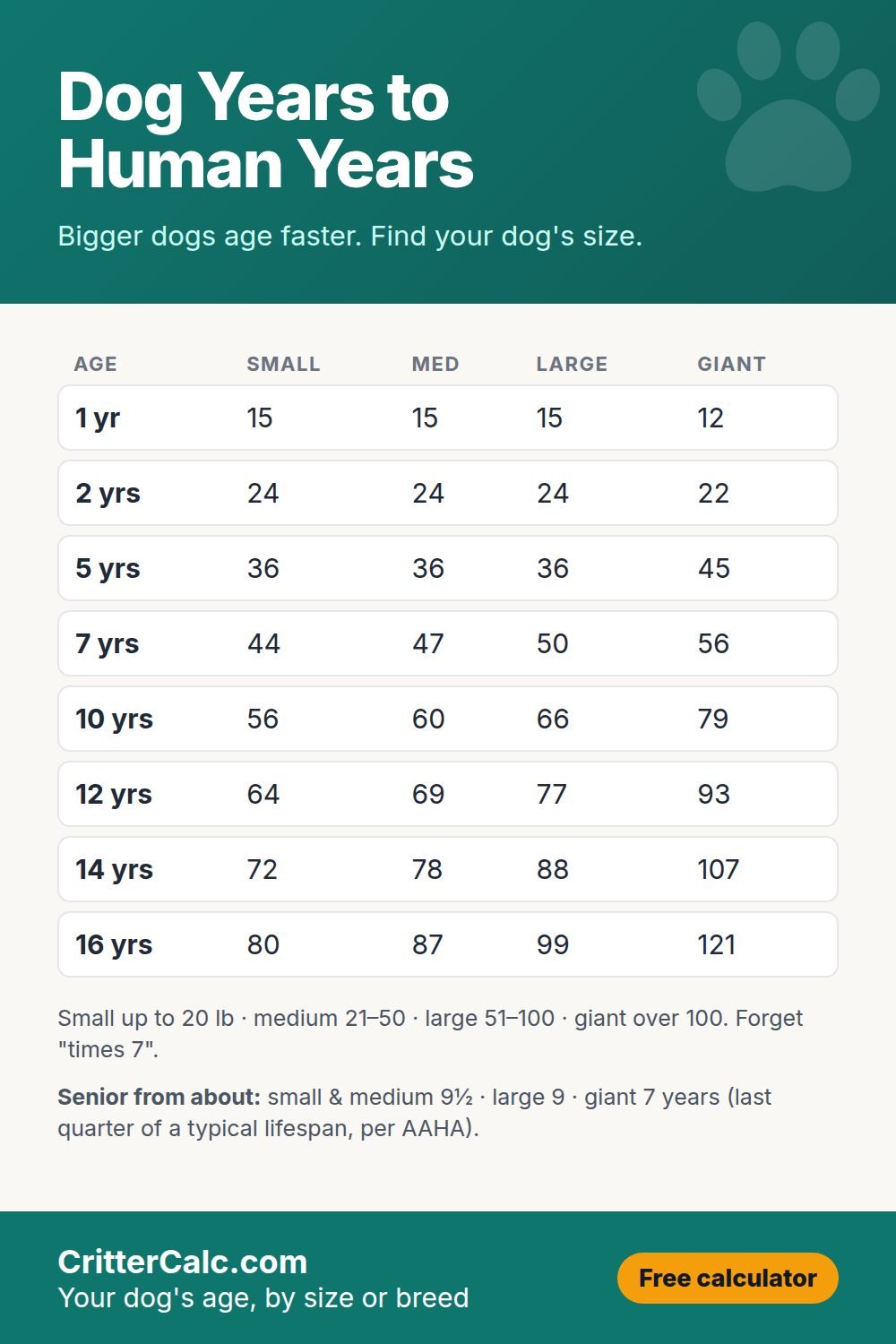
This dog age chart uses the size-based numbers that many vet clinics hand out. The first two years follow AVMA guidance. Sizes go by adult weight: small is up to 20 lb, medium 21 to 50 lb, large 51 to 100 lb and giant is over 100 lb. You can print it or embed it on your own site.
| Dog’s age | Small | Medium | Large | Giant |
|---|---|---|---|---|
| 3 months | 5 | 5 | 5 | 4 |
| 6 months | 10 | 10 | 10 | 8 |
| 1 year | 15 | 15 | 15 | 12 |
| 2 years | 24 | 24 | 24 | 22 |
| 3 years | 28 | 28 | 28 | 31 |
| 4 years | 32 | 32 | 32 | 38 |
| 5 years | 36 | 36 | 36 | 45 |
| 6 years | 40 | 42 | 45 | 49 |
| 7 years | 44 | 47 | 50 | 56 |
| 8 years | 48 | 51 | 55 | 64 |
| 9 years | 52 | 56 | 61 | 71 |
| 10 years | 56 | 60 | 66 | 79 |
| 11 years | 60 | 65 | 72 | 86 |
| 12 years | 64 | 69 | 77 | 93 |
| 13 years | 68 | 74 | 82 | 100 |
| 14 years | 72 | 78 | 88 | 107 |
| 15 years | 76 | 83 | 93 | 114 |
| 16 years | 80 | 87 | 99 | 121 |
Puppy months are our estimate along a smooth curve to the 1-year mark. Giant breeds start a little “younger” and then pass the others around age 3.
The DNA formula: a second opinion
In 2020, researchers at UC San Diego compared age-related chemical changes in the DNA of Labrador Retrievers and people. Their formula is: human age = 16 × ln(dog age) + 31. “ln” is the natural log, which any phone calculator has.
It gives very different numbers from the chart. A 1-year-old dog comes out at 31, a 2-year-old at about 42 and a 10-year-old at about 68. In other words, dogs age very fast early on and then slow right down.
We show it next to the main result for dogs aged 1 and up. Keep in mind it came from one breed, and the study didn’t look at how size changes things. For everyday use (and for talking to your vet about life stages) the size chart is the better guide.
Dog life stages: when is a dog a senior?
The American Animal Hospital Association (AAHA) splits a dog’s life into stages. Two of them, mature adult and senior, depend on how long a dog of that size or breed usually lives. A dog counts as a senior in the last 25% of its expected lifespan.
- Puppy: birth until rapid growth stops, around 6 to 9 months depending on size.
- Young adult: until the body and behavior are fully mature, which most dogs reach by 3 to 4 years.
- Mature adult: from then until the last quarter of the expected lifespan.
- Senior: the last quarter of life, through the end of life.
Here’s how that works out using typical lifespans by size. The calculator uses the same numbers.
| Size | Typical lifespan | Senior from about |
|---|---|---|
| Small (up to 20 lb) | 12.7 years | 9½ years |
| Medium (21–50 lb) | 12.5 years | 9½ years |
| Large (51–100 lb) | 11.9 years | 9 years |
| Giant (over 100 lb) | about 9 years | 7 years |
Small, medium and large figures are median lifespans from a 2024 UK study of more than 580,000 dogs. That study didn’t report a giant group, so the giant figure is based on giant breeds in it, such as the Mastiff (9.0 years) and Saint Bernard (9.3).
These weight bands follow the lifespan groups above, so they are not the same as the size classes in our dog size calculator (there, medium means 25 to 55 lb). That one sorts dogs by adult build, this one by how long dogs of that weight usually live.
Senior dogs do best with a checkup every 6 months. Things to watch: weight loss or gain, stiffness getting up, drinking or peeing more, bad breath, lumps, and any confusion or night-time restlessness. These are easy to write off as “just getting old”, but many of them can be treated.
Does breed matter, or just size?
Mostly size, but breed plays a part. In the same 2024 study, Labradors and Border Collies had a median lifespan of 13.1 years and Miniature Dachshunds 14.0. Flat-faced breeds did worse for their size. French Bulldogs and Bulldogs had a median of 9.8 years, and Pugs 11.6.
The longest-lived breeds were small ones with normal-length noses, like the Lancashire Heeler (15.4 years), Tibetan Spaniel (15.2), Shiba Inu (14.6) and Papillon (14.5). At the other end were big, heavy breeds such as the Cane Corso (8.1).
That’s why the calculator lets you pick a breed. It sets the size class for you. If your breed isn’t listed or you have a mix, go by your dog’s adult weight. Not sure what that will be? Our dog size calculator can estimate it.
Got more than one dog? Compare them
Enter up to four dogs with their sizes to see who’s oldest in human years. It’s a good one for homes with a big dog and a small dog, since the gap between them keeps growing every year.
Human years to dog years
You can run the chart backwards too. Pick “Human years to dog years” in the calculator and enter any age. For example, 50 human years lines up with a small dog of about 8½, a medium dog of about 7¾, a large dog of about 7 and a giant dog of about 6.
How to tell a dog’s age if you don’t know it
Rescue dogs often come without a birthday. A vet can give the best estimate, but these clues help:
- Teeth. Puppies have all their adult teeth by about 6 to 7 months. Tartar, yellowing and worn edges build up with age.
- Eyes. A bluish haze in the lens (nuclear sclerosis) is common from middle age on.
- Muzzle and coat. Gray around the muzzle is a hint, though some dogs go gray early.
- Body and energy. Older dogs lose muscle over the back and hips and take longer to get up.
Once you have a rough age, pick a best-guess birthday in the calculator so the milestone dates line up.
Frequently asked questions
How old is a 12-year-old dog in human years?
About 64 to 93, depending on size. A small dog is about 64, a medium dog 69, a large dog 77 and a giant breed about 93.
How old is a 14-year-old dog in human years?
About 72 for a small dog and 78 for a medium dog. A large dog is about 88, and a giant breed that reaches 14 is doing remarkably well.
How old is a 10-year-old dog in human years?
Between 56 and 79. Small dogs are about 56, medium 60, large 66 and giant breeds about 79.
How old is a 5-year-old dog in human years?
About 36 for small, medium and large dogs, and about 45 for a giant breed.
Is 1 year 7 years in dog years?
No. A 1-year-old dog is closer to 15 in human years (about 12 for giant breeds). The “times 7” rule is a myth.
At what age is a dog a senior?
It depends on size. Using AAHA’s “last 25% of lifespan” rule, small and medium dogs are seniors from about 9½, large dogs from about 9 and giant breeds from about 7.
Is 20 old for a dog?
Yes, very. Few dogs reach 20. The oldest dog on record, an Australian Cattle Dog named Bluey, lived to 29 years and 5 months.
Why do big dogs age faster than small dogs?
Nobody knows for sure. One leading idea is that big breeds grow so fast as puppies that it speeds up age-related wear later on.
How long do dogs live?
About 12.5 years on average in the 2024 UK study. Small breeds with normal noses tend to live longest, and giant and flat-faced breeds the shortest.
Save to Pinterest